
Person
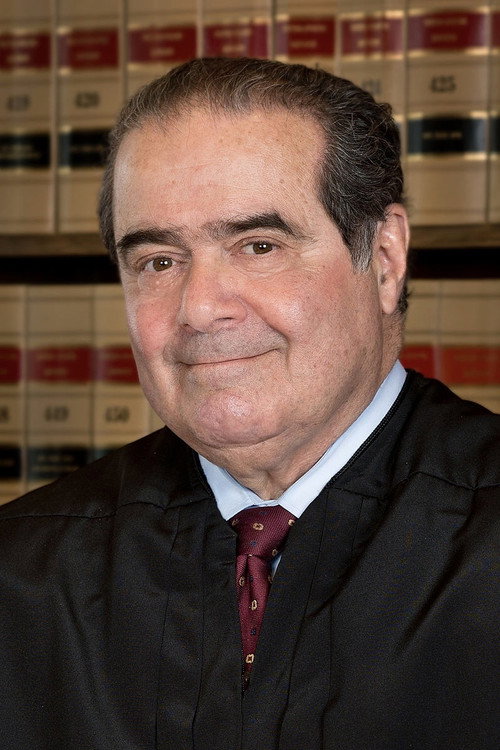
Antonin Scalia
In short · Worked for one decade — 2 credits.
Help complete this page
We’re missing one-line descriptor. Sign in to add what you know.
Biography
Antonin Gregory Scalia (March 11 1936 – February 13 2016) was an American jurist who served as an Associate Justice of the Supreme Court of the United States from 1986 until his death in 2016. He was described as the intellectual anchor for the originalist and textualist position in the Court’s conservative wing, and has been characterized as one of the most influential jurists of the twentieth century and a significant figure in Supreme Court history. Scalia received the Presidential Medal of Freedom posthumously in 2018, and George Mason University named its law school after him.
Scalia was born in Trenton, New Jersey. A devout Catholic, he attended Jesuit Xavier High School and earned an undergraduate degree from Georgetown University before graduating from Harvard Law School. He worked six years at Jones Day, then became a law professor at the University of Virginia. In the early 1970s he served in the Nixon and Ford administrations, eventually becoming an assistant attorney general under President Gerald Ford. During most of the Carter administration he taught at the University of Chicago, where he was among the first faculty advisers of the Federalist Society. President Ronald Reagan appointed him to the U.S. Court of Appeals for the District of Columbia Circuit in 1982 and four years later nominated him to the Supreme Court; his confirmation by the Senate was unanimous, 98–0, making him the Court’s first Italian‑American justice.
Scalia advocated a conservative jurisprudence, promoting textualism in statutory interpretation and originalism in constitutional interpretation. He circulated “Ninograms,” memos named for his nickname “Nino,” to persuade colleagues of his views. He defended executive power, held that the Constitution permits the death penalty, and argued it does not guarantee rights to abortion or same‑sex marriage. He regarded affirmative action and similar policies granting special status to minority groups as unconstitutional, a stance that contributed to his reputation as one of the Court’s most conservative justices. He frequently authored separate opinions, often sharply criticizing majority rulings. Notable opinions include his dissent in Morrison v. Olson, his majority opinion in Crawford v. Washington defining Sixth‑Amendment confrontation rights, and his majority opinion in District of Columbia v. Heller holding that the Second Amendment guarantees an individual right to handgun ownership.
Memorable quotes
Browse all →No quotes logged for Antonin Scalia yet — add the first memorable line below.
Got a quote we’re missing?
Submit a line from any film, show, or game.
Additional credits2Show
Non-headline appearances — talk-show, awards-show, panel, and archive-footage credits, kept separate from the main filmography.
- Capitalism: A Love StorySelf (archive footage) · 2009
- Fahrenheit 9/11Self · 2004
Edit history
Loading edit history…
Comments (0)
on Antonin ScaliaNo comments yet. Be the first to share what you think.